Just Because AI Can Fill Every Page Doesn't Mean It Should
A few days ago I ran an audit for a chiropractic clinic. A few locations, a decent budget, and a familiar story behind it: they’d been through a string of agencies, nothing had really stuck, and they’d quietly drifted over to Meta because at least there it felt like something was happening.
I didn’t have access to their account yet, so I did what I always do first. I pulled the site and their competitors apart in my research tools to see what the market actually looks like. And the moment their landing page loaded, I knew exactly what had gone wrong.
It was enormous. The page for one single service, let’s call it back pain, had been built to cover every conceivable angle of back pain on Earth. Scroll, scroll, scroll. Every cause: muscle strain, herniated discs, arthritis, poor posture, stress, pregnancy, “sleeping awkwardly,” sitting at a desk too long. Every symptom: stiffness, tingling, numbness, shooting pains, reduced mobility, headaches that “might be referred from the neck.” Every treatment under the sun: adjustments, spinal mobilisation, dry needling, soft-tissue work, corrective exercise, posture plans. All of it, on one page, in long earnest paragraphs explaining back pain back to the person who is sitting there with back pain.
You can tell when AI has written a page like this. It reads like someone typed “write me a comprehensive page about back pain” and pasted the lot straight onto their site. It wasn’t written to convert anybody. It was written to be complete. As if stuffing the page with every word that has ever been associated with back pain might, somehow, drag a customer over the line.
You can fill a page in thirty seconds now. That’s the problem.
For the first time, anyone can produce a wall of plausible, on-topic copy in the time it takes to make a cup of tea. And so people do. Why write one tight page when AI will write you ten? Why cover the main thing when you can cover everything?
But here’s what I keep seeing in 2026. AI’s instinct is always to add. It’s trained on the whole internet, and the internet’s answer to “what should be on this page” is “more.” More headings, more sections, more reassurance, more caveats, more keywords squeezed in sideways. Point it at a landing page and it will faithfully give you a page that says a great deal and sells nothing.
I’ve written before that AI is brilliant at producing the average. This is the same thing showing up on the page instead of in the account. The average page covers all bases. The page that wins does the opposite.
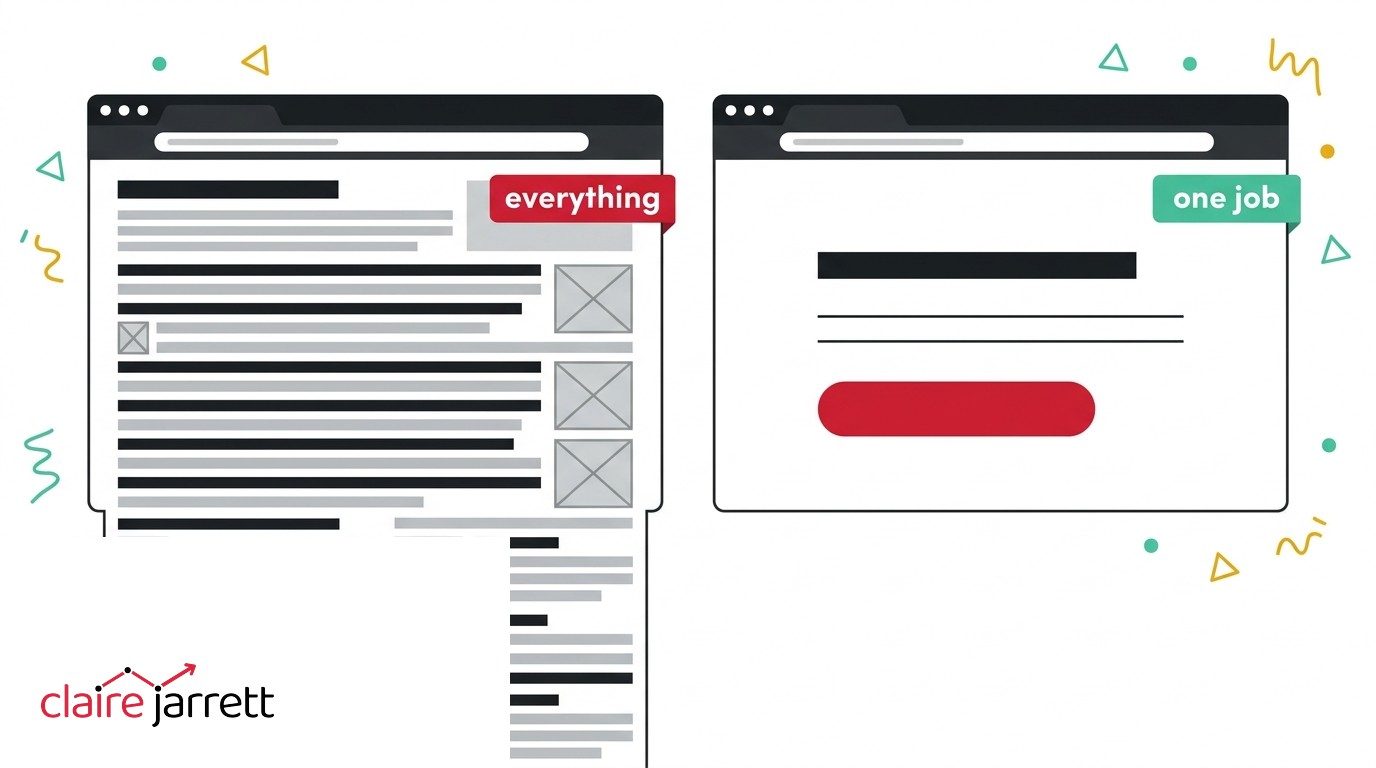
A landing page has one job
Somebody who has just typed “chiropractor near me” into Google because their back is hurting does not want a medical encyclopaedia. They want to know that you can help, that you’re nearby, what it’ll cost them roughly, and what to do next. That’s it.
A good landing page answers one question, what’s in this for me, and what do I do now, and gets out of the way. The clinic’s page answered a completely different question: what is back pain? Nobody searching for relief needs that explained to them. They’re living it.
A page that tries to say everything ends up selling nothing.
That’s the bit that gets lost. When you cram every cause and every symptom onto one page, the one thing the visitor actually needs, a clear next step, gets buried under three thousand words they were never going to read. The page isn’t thorough. It’s just in the way.
What the competitors winning were actually doing
So I went and looked at the two clinics quietly cleaning up in that same area. Neither was doing anything clever.
One page per service. A page for back pain. A page for neck pain. A page for sports injuries. Each one short, plain, and pointed straight at a single problem. Every keyword tied to a place, chiropractor near me, back pain clinic [town], so Google knew exactly who to show them to. And one call to action, repeated: book a free 15-minute assessment. That was the whole offer. No essay. No wall of symptoms. A clear problem, a clear promise, a clear next step.
That’s it. That’s the thing my prospect was losing to. Not a slicker brand, not a bigger budget, just clarity. As I said on the call, I could overtake those pages in my sleep, and so could they, the moment they stop trying to say everything at once.
More is not the same as better
There’s a version of this that has nothing to do with AI, and I see it constantly: people who mistake building more for doing it properly.
I spoke recently to a practitioner who’d built a separate page for every single thing he treats. Dozens of them, lovingly made, one for every niche problem he could think of. Genuinely more thorough than any of his competitors. And Google was showing almost none of them, while a rival with one scruffy, dated page sat at the top of the results for everything. He couldn’t understand it. He’d done more. Surely more wins?
It doesn’t. He’d spread himself so thin that nothing was strong enough to rank, and the structure underneath it all was working against him. The competitor with the single ugly page had, by accident, done the one thing that mattered: kept it simple enough that Google and the customer could both follow it.
Building more is not the same as building right. AI has just made “more” effortless, which means the temptation has never been stronger, or easier to give in to.
What I’d actually do
If you’ve used AI to build out your pages, or you’re about to, here’s where I’d start.
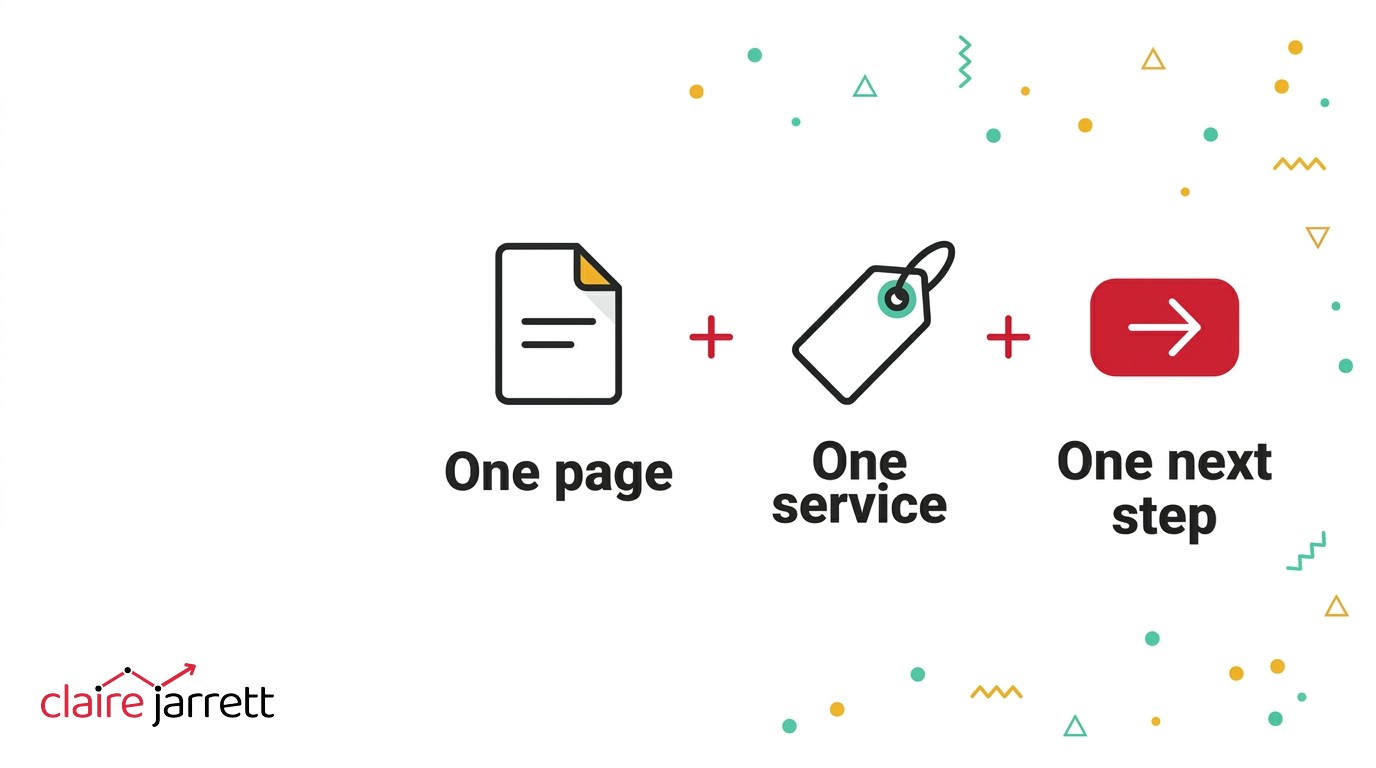
- One page, one service, one next step. If a page is trying to cover three problems, it’s three pages. Pick the single thing the visitor searched for and speak only to that.
- Lead with the outcome, not the problem. They already have the problem. Tell them what life looks like once it’s sorted, and how to get there. Don’t explain their own symptoms back to them.
- Cut anything that doesn’t move them towards the call. Read every section and ask: is this helping them act, or just filling space? If it’s filling space, it’s costing you. Out it goes.
- Tie every page to a place. Near me and the town name belong in the keywords and on the page. Vague national copy loses to a local rival every time.
- Let AI tidy, not generate. It’s superb for sharpening a line, fixing your spelling, suggesting a clearer heading. It’s a terrible judge of what to leave off, and on a landing page, what you leave off is the whole game. There’s a proper guide to writing copy that converts if you want the longer version.
The bigger point
This is the same problem I’ve been writing about all month, just landing somewhere new.
Google’s own AI quietly adds keywords and switches you to broad match. Left to optimise on its own, it chases more and more of the wrong conversions. And the whole platform has got harder to read, not easier, because every layer of automation adds something. Now AI is doing the exact same thing to the page itself: adding, expanding, covering every base, never once asking whether any of it should be there.
AI adds. It will always add. The skill that actually matters now, on the account and on the page, is knowing what to take away. Tight ad groups instead of one giant campaign. Negative keywords instead of every search going. One clear page instead of an essay. The judgement to leave things off is the one thing the machine doesn’t have, and it’s exactly the thing that wins.
If you’ve built your pages with AI and you’re not sure whether they’re working for you or just talking at people, that’s what an audit is for. I’ll look at the pages and the account, tell you what’s actually pulling its weight and what’s just noise, and you decide what to do with it. You know where I am.
A few questions I get asked
Can’t I just use AI to write my landing pages? You can use it to help: to sharpen a sentence, tidy your copy, suggest a heading. What it can’t do is decide what to leave off, and on a landing page that’s the whole job. Left to itself it will give you a thorough page that covers everything and converts no one.
Why is a shorter page better? It isn’t shorter for the sake of it. It’s focused. Someone who’s just searched for help wants a clear answer and a clear next step, not three thousand words explaining a problem they already have. Every extra section you add is one more thing between them and booking.
How many landing pages do I actually need? One per service you genuinely want to be found for, each pointed at a single problem and a single place. Not one giant page trying to be all things, and not fifty thin ones spread so wide that none of them is strong enough to rank.
My page covers everything, isn’t that good for SEO? Covering everything badly helps nobody. A focused page that clearly answers one search, tied to a location, will outperform a sprawling catch-all for both Google Ads quality score and the person reading it. Relevance beats volume.
Two ways I can help you get this right
Not sure whether your pages are bringing in leads or just filling space? Book a free Google Ads call and I’ll go through your account and your landing pages with you, and tell you the truth about what I find.
Or register for my free masterclass, How to Overtake Your Top Google Ads Competitors in 8 Weeks, and I’ll walk you through the whole approach.

Claire Jarrett
Google Ads consultant since 2007, published author (6 books), and Google Partner. Claire was the first person to launch Google Ads training in Europe and has helped thousands of professional service businesses scale their leads.
More about Claire