You Can't Test Google Ads on a Budget That Was Never Going to Work
I spoke to the owner of a landscaping company recently who had, in his words, given up on Google Ads. He’d spent thousands of dollars over time and never once got a job out of it. Not one. Every other channel worked for him, the trade directories, the referrals, even the home shows he hated. Google was the only place he’d never seen a single conversion.
So I asked him what he’d actually tried. And there it was. He’d tested it at $10 a day. He’d chased the cheapest clicks he could find, $1 or $2 each, watching the numbers, pulling the budget the moment it felt scary. He’d met Google’s own reps 5 times, tried Search, tried Performance Max, tried “clicks”, tried “conversions”. And when none of it worked, he did what a lot of people do now: he ran Google’s advice through Gemini, which told him to ignore Google, and left him more confused than when he started.
Here’s the thing I had to tell him, as gently as I could. It was never going to work. Not because Google Ads doesn’t work for landscapers, it absolutely does. Because you cannot test Google Ads on a budget that was never big enough to enter the race in the first place.
Cheap clicks aren’t a cheaper version. They’re a worse auction.
This is the bit almost everyone gets wrong, so let me be plain about it.
When you go hunting for $1 and $2 clicks, you are not buying a cheaper version of the same customer. You’re buying a completely different, worse one. Google knows exactly who its cheap clicks are. They’re the people idly browsing, comparing, tyre-kicking, the ones nowhere near ready to hire anyone. The expensive clicks, the $10 ones, are the people who typed in exactly what you offer and are ready to buy right now. Your competitors are already paying for those. To compete, you have to be in the same auction.
So when he set his budget at $10 a day and optimised for cheap clicks, he wasn’t running a small version of a real campaign. He was fishing in the wrong pond entirely, and catching exactly the wrong fish.
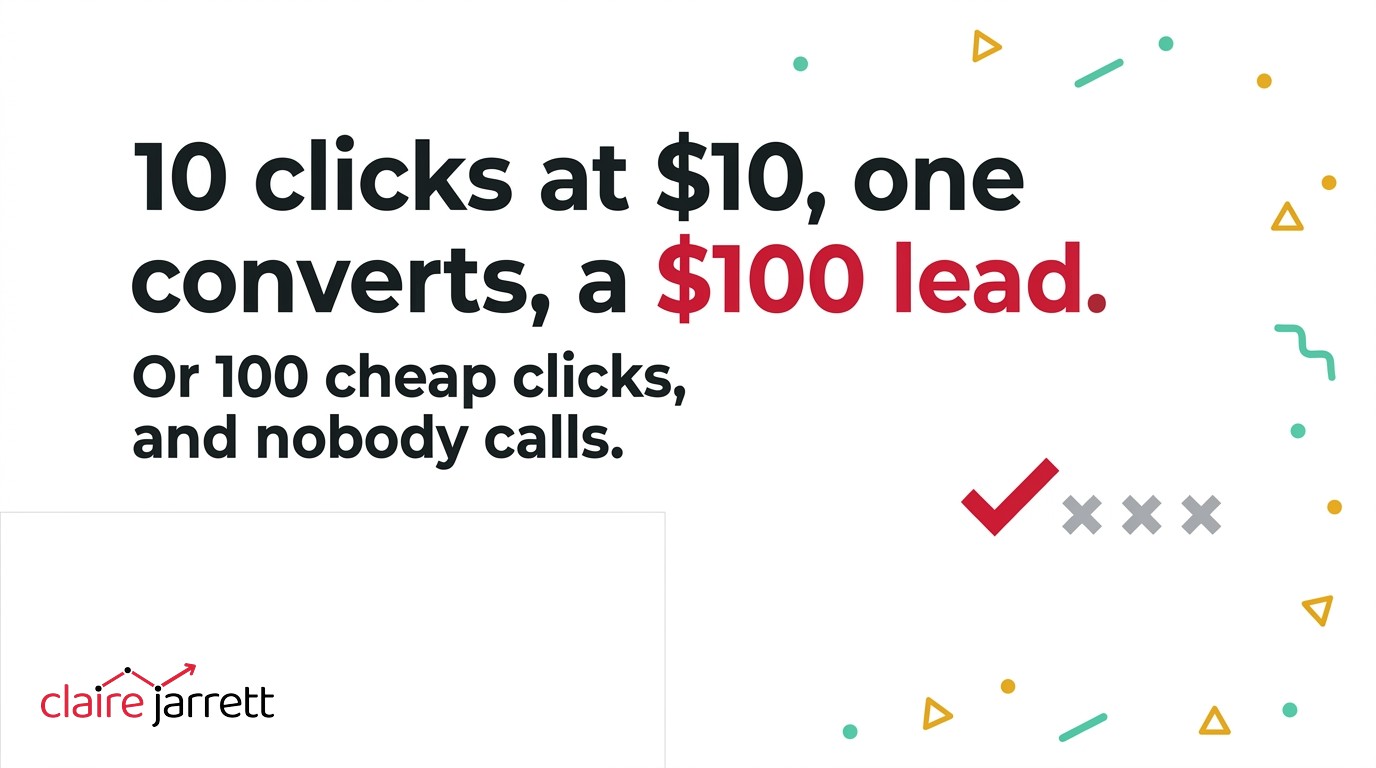
The maths is the part that frees people. For a $100 lead, I would far rather have 10 people who cost $10 a click, where one of them converts, than 100 cheap clicks where nobody ever calls. Fewer clicks, better clicks. That is the opposite of how most people instinctively test, which is why most people’s tests fail.
A bigger budget isn’t the fix either
Now, the obvious reaction to all this is “so I just need to spend more and I’ll show up more.” That’s not it either, and this is worth understanding.
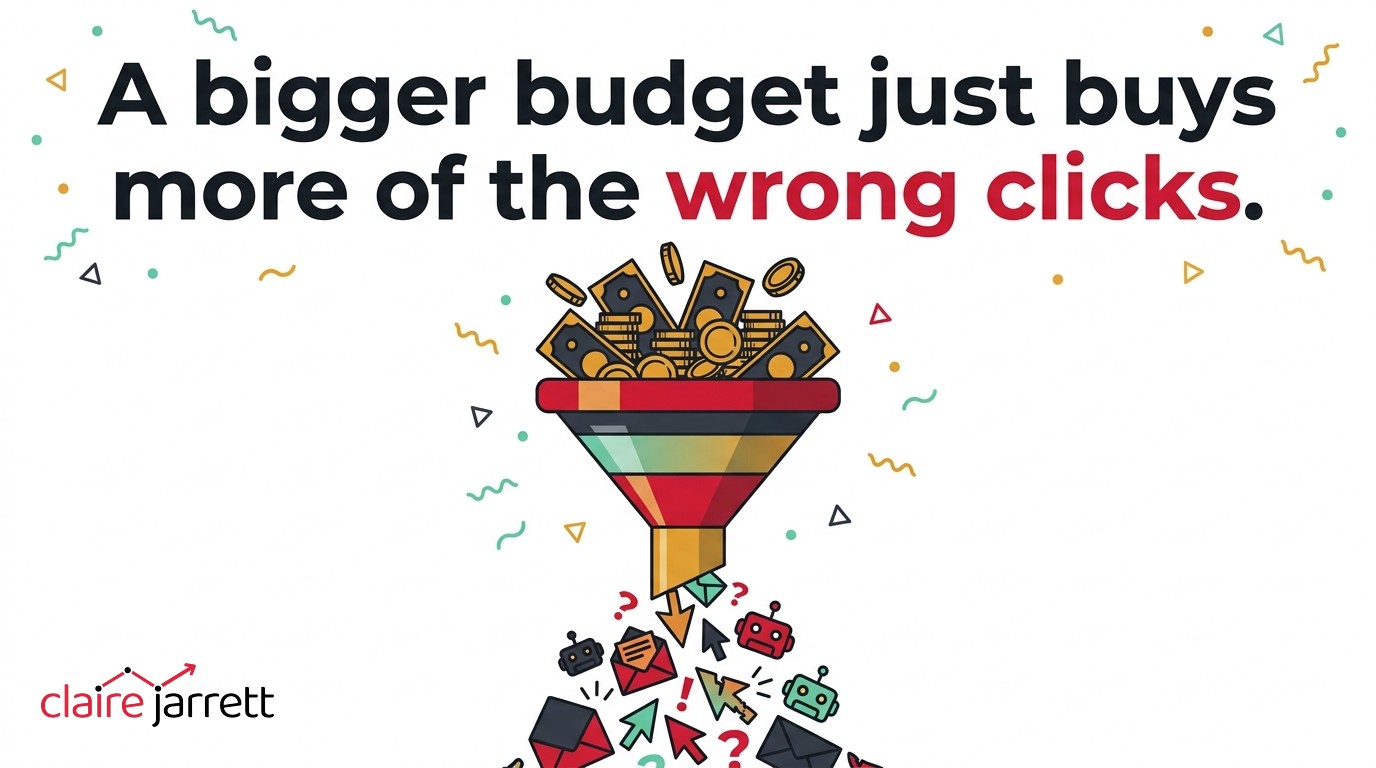
He asked me directly: with a bigger budget, would my ad just show to many more people? No. We don’t want your ad seen by more people. We want it seen by the right ones. A bigger budget doesn’t buy more eyeballs. It buys you into the better auctions, against the searchers who are actually ready to hire, with a campaign built tightly enough that Google isn’t wasting the money on junk traffic. Spend more on a badly built account and all you do is buy more of the wrong clicks, faster.
I see the same thing at the other end of the scale. Another owner I spoke to had been warned that ads “run away with you”, so she was thinking £4 to £20 a day. That’s not a test. That’s too little to give Google anything to work with, and it will teach you nothing except that small budgets don’t perform. The honest answer is that some businesses shouldn’t run Google Ads at all until they’ve a real budget to compete with. That’s not a sales line. It’s just the truth about the auction.
We don’t want your ad seen by more people. We want it seen by the right ones.
Where AI quietly makes this worse
Here’s the modern twist, and it’s the reason the landscaper was stuck rather than just wrong.
When the cheap test fails and Google’s own advice confuses you, the reflex now is to hand the whole thing to AI and let it sort out the budget. And AI will happily oblige. Tell it you want to test Google Ads on $10 a day chasing cheap clicks, and it will agree it’s a sensible, cautious way to start. It will never stop you and say the thing I just said: that this budget was never going to work, and you’re testing the wrong thing entirely. It’s built to be agreeable, not to be right. It will never tell you no.
And if you wire it up to actually run the account on that starvation budget, it does something worse. It optimises towards the cheap conversions it can find, the low-intent junk, and goes looking for more of the same, confident the whole way down that it’s winning. You end up with a machine enthusiastically perfecting a test that was doomed before it began.
That landscaper running Google’s advice through Gemini is the whole problem in one image. 2 confident machines, contradicting each other, and no judgement underneath either of them. What he needed wasn’t a third opinion. It was someone to tell him the budget was the problem, not the platform.
What I’d actually do
If you’ve tried Google Ads, it didn’t work, and you’re wondering whether to walk away, here’s where I’d look first.
- Check what you actually tested. If it was £10 or $10 a day, or you were chasing the cheapest clicks you could find, you didn’t test Google Ads. You tested whether cheap traffic converts, and it doesn’t. That result tells you nothing about the real thing.
- Work out the real cost of a lead in your market. Look at what your competitors are paying to be there. In most professional services it’s a proper number, not pennies. If that number doesn’t make sense against what a customer is worth to you, Google Ads may genuinely not be for you, and I’d rather tell you that now.
- Budget to win the right clicks, not to buy more of them. More spend on a loose account just buys more junk. The goal is fewer, better-qualified clicks, which means a tight build and a budget big enough to compete for the people who are ready to buy.
- Don’t let AI bless a doomed test. By all means use it to understand your numbers or draft your negatives. But it will never tell you your budget was too small to work, because it never tells you no. That judgement has to come from someone who’s watched 1,000 of these.
The bigger point
Most of the people who tell me Google Ads doesn’t work never actually ran it. They ran a starved, cheap-clicks version of it, on a budget that was never going to compete, and quite reasonably concluded it was useless. Then they hand that same doomed test to an AI that cheerfully agrees and optimises it harder.
Google Ads works. Cheap Google Ads, on a budget built to lose, does not, and no amount of automation on top of it will change that. The businesses that win are the ones willing to enter the real auction, with a real budget, built tightly enough that every pound goes on the right click. Everything else is just an expensive way to prove a point that was never true.
If you’ve written Google Ads off and you’re not sure whether it was the platform or the budget that failed you, that’s what an audit is for. I’ll look at what you actually ran and tell you the truth, including if it genuinely isn’t for you. You know where I am.
A few questions I get asked
How much should I budget to properly test Google Ads? Enough to compete for the clicks that actually convert in your market, which is usually far more than the $10-a-day most people try. The honest figure depends on what a customer is worth to you and what your competitors are paying to reach them. If a realistic budget doesn’t make sense against your margins, that’s worth knowing before you spend, not after.
Why did I get clicks but no conversions? Almost always because you were buying the wrong clicks. Cheap traffic is cheap because Google knows those people are lower intent: browsing, comparing, not ready to buy. Fewer, more expensive, better-qualified clicks will out-convert a pile of cheap ones every time.
If a small budget doesn’t work, will a big one fix it? Not on its own. A bigger budget on a badly built account just buys more of the wrong traffic. The budget has to go hand in hand with a tight setup so the money is spent competing for ready-to-buy searchers, not sprayed across junk.
Can’t I just let AI manage a small test budget for me? It’ll happily do it, and that’s the danger. AI won’t tell you the budget was never going to work, because it’s built to agree with you. Left to run a starved account, it optimises towards the cheap, low-intent conversions and chases more of them. You get a doomed test, run with great confidence.
2 ways I can help you get this right
Not sure whether it was the platform or the budget that let you down? Book a free Google Ads call and I’ll look at what you actually ran and tell you the truth about it.
Or register for my free masterclass, How to Overtake Your Top Google Ads Competitors in 8 Weeks, and I’ll walk you through the whole approach.

Claire Jarrett
Google Ads consultant since 2007, published author (6 books), and Google Partner. Claire was the first person to launch Google Ads training in Europe and has helped thousands of professional service businesses scale their leads.
More about Claire