You Get What You Pay For in Google Ads. AI Just Made the Cheap Version Free.
Last week I audited an account for the owner of a private physiotherapy clinic. He’d been paying a cheap provider a few hundred dollars a month to run the lot, every treatment he offers thrown in together. His honest summary of how it was going was that none of it was working, and he wanted to know why before he spent another penny.
So I opened the account and looked. And within about 30 seconds I could have told him why, because it’s a story I see almost every week.
The setup wasn’t broken, exactly. It was just cheap. One campaign, every service thrown in together, phrase match on everything, and not a single negative keyword added. As I said to him on the audit: it’s not bad. It’s just not good. And it’s certainly not great. It’s Google Ads 101, and you can feel the corner that was cut in every part of it.
That’s what “you get what you pay for” looks like inside a real account. And here’s the part that’s new in 2026: you no longer even have to pay for the cheap version. AI will build you the identical thing, in an afternoon, for free.
What the cheap setup actually does to your money
Here’s the mechanism, because it matters. Google will always default to wherever it can find traffic the easiest. Put one broad keyword with 6,000 searches in the same campaign as 10 specific, profitable ones that get a couple of hundred each, and Google pours your budget into the big lazy one. It’s the higher-volume keyword precisely because it’s less specific, and less specific means less likely to convert.
So when everything is chucked into one campaign, the profitable services quietly starve.
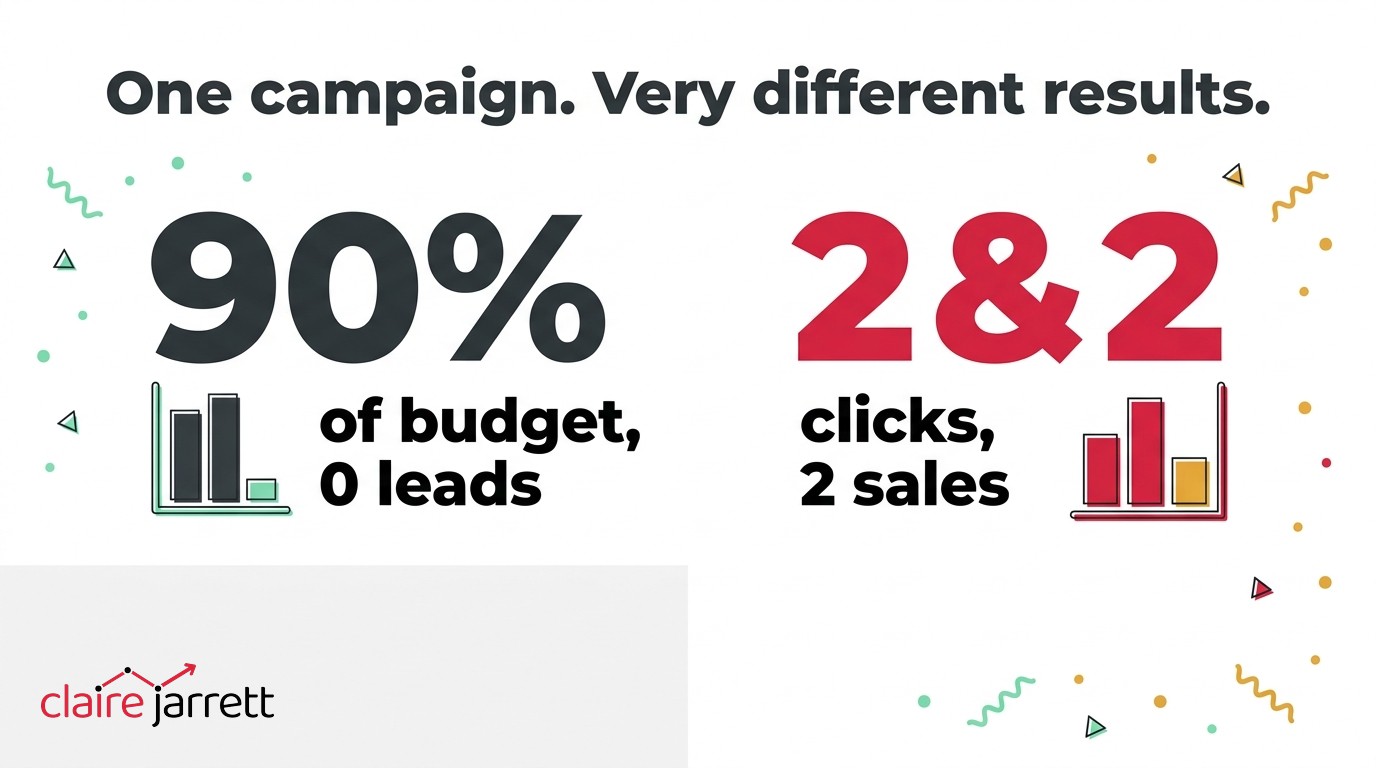
I could prove it to him live in his own account. His broadest keyword, “physiotherapy near me”, was eating the overwhelming majority of the budget, something like 90% of it, and had brought in 0 genuine enquiries. Meanwhile sports injury rehabilitation, tucked in the same campaign and starved of budget, had scraped a handful of impressions, 2 clicks, and 2 booked patients. 2 out of 2. Imagine what that would have done with a campaign of its own. Shockwave therapy, one of his most profitable treatments, had taken a dozen clicks to land a single booking. The money was going to the one place it shouldn’t, and the things that actually paid never got a look in.
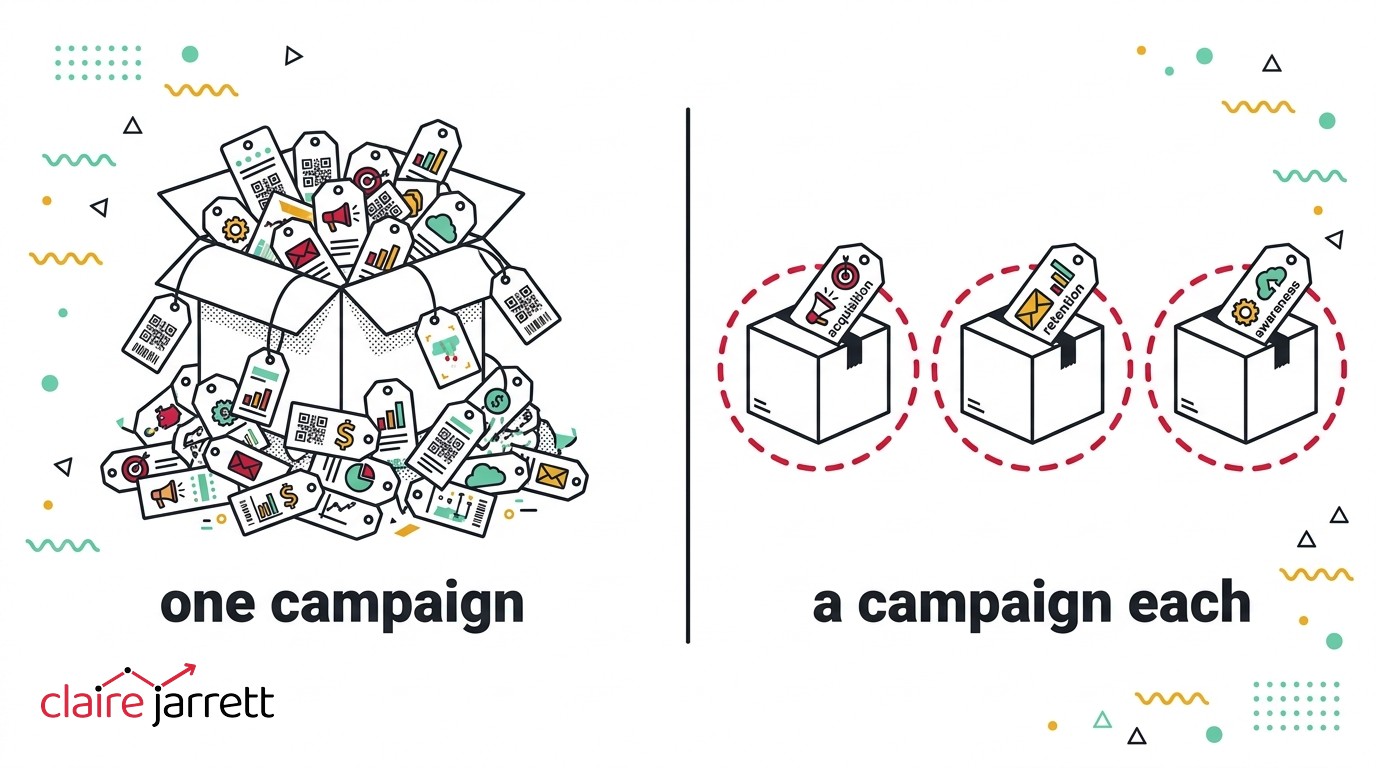
None of this is exotic. The fix is the first thing I teach the teams I train: one campaign per service, so the budget is ring-fenced and Google can’t rob one to feed another. The second thing I teach them is negative keywords. In his account, I searched through more than 1,000 terms his ads had shown for, looking for a single one that had been excluded. There wasn’t one. He was paying for “physiotherapist salary”, for “physio exercises for lower back pain”, for competitors, for people hunting the cheapest possible session. Negative keywords are what make or break an account, and his had none.
Then there were the landing pages. His sports-injury ad sent people to the general homepage. His “shockwave therapy” ad went to a page listing every treatment the clinic offers. None of it matched what the person had actually searched for.
Now the free version, which makes the exact same mistakes
Here’s why this matters more than it used to. For the first time, anyone can build a Google Ads campaign in an afternoon by asking ChatGPT or Claude to do it. And it will. Keywords, structure, ad copy, the lot. Then it’ll congratulate you and tell you you’ve just saved yourself a management fee.
The trouble is what it builds. I’ve written before that AI learned the job from the people getting it wrong, because it’s trained on the whole internet, and most of the internet’s Google Ads advice is exactly the setup I’ve just described. One campaign. Everything in. Phrase match. No negatives. It gives you a confident, tidy, average account, which is precisely the account I’ve spent 19 years unpicking.
So “cheap” now has 2 faces. There’s the provider charging a few hundred a month who cuts every corner. And there’s the AI that charges nothing and cuts the same ones. Both hand you the average, and in any competitive market, average loses money.
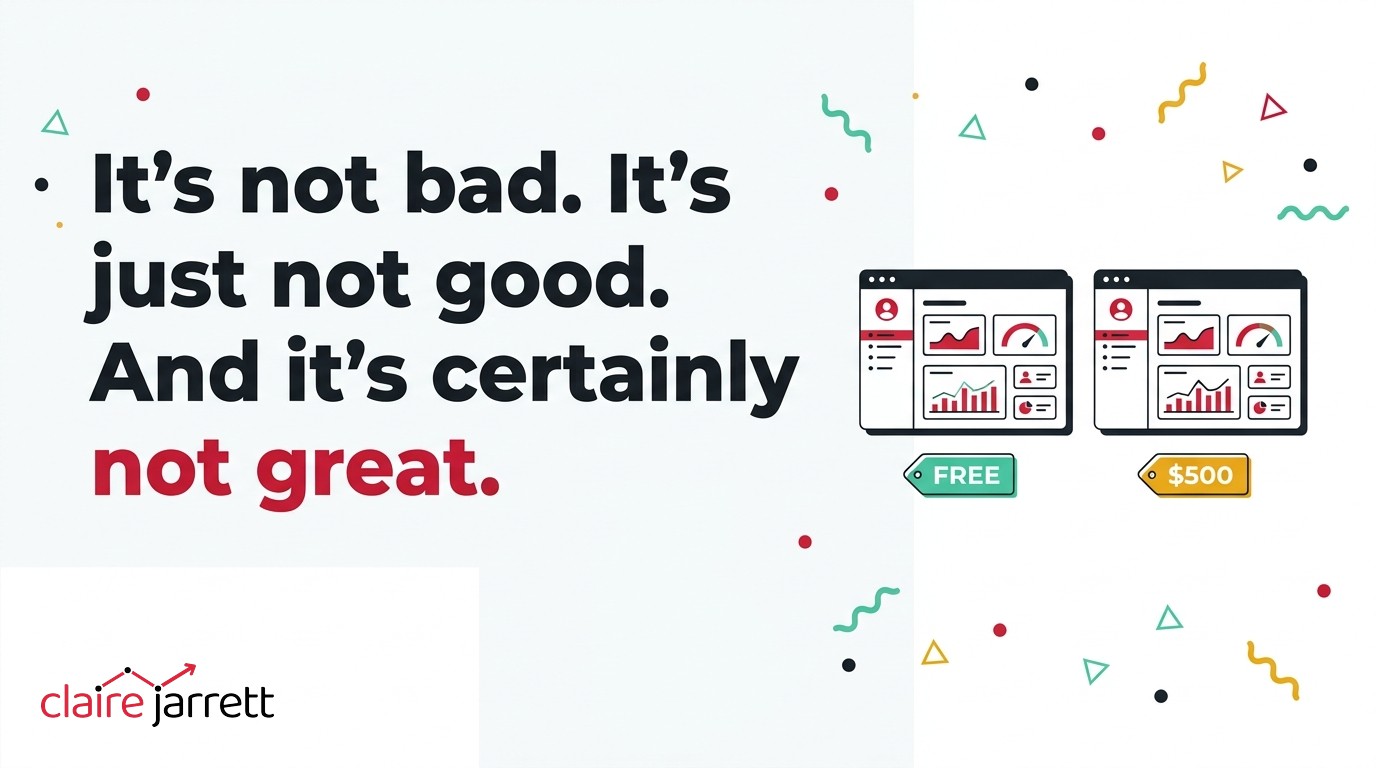
It’s not bad. It’s just not good. And it’s certainly not great.
And then Google’s AI finishes the job
Here’s where the cheap build and AI meet in the worst possible way. Once you’ve got an account like this, with everything lumped together, and you let Google’s own automation “optimise” it, the automation does what it’s built to do: it finds the easiest, highest-volume traffic and chases more of it. It feeds the lazy keyword harder. The “physiotherapy near me” term that was already eating 90% of the budget just eats more. It’s the same failure I describe in you can’t test Google Ads on a budget that was never going to work: automation faithfully perfecting a setup that was doomed from the start.
That’s the death spiral I’ve written about landing on a poorly built account. A tight, well-structured account gives the automation something sensible to amplify. A cheap one gives it a mess to scale, faster and harder, while your dashboard tells you everything’s fine.
What I’d actually do
If you’ve bought the cheap setup, or built the free AI one, here’s where I’d start before spending another penny on clicks.
- Split it up by service. If one campaign is carrying every service you offer, that’s your single biggest leak. One campaign per service, so the budget for each is ring-fenced and Google can’t starve your best performers to feed your broadest keyword.
- Add negatives from day one. Pull your search terms report and read what you’re actually paying for. Every “free”, every “cheap”, every competitor name, every question from someone who was never going to buy. Exclude them. In the first month this is the highest-value hour you’ll spend.
- Match every page to the search. If someone searched for sports injury rehabilitation, they should not land on a generic homepage. Whatever they typed is the promise; the page has to keep it.
- Check what’s eating the budget. Look at which keyword is taking the spend and what it’s bringing back. If your broadest term is soaking up the money and converting no one, that’s the account robbing itself.
- Use AI to read the account, not to build it. It’s genuinely brilliant for explaining what a report means or drafting a batch of negatives for you to approve. It’s brilliant at answering enquiries and following up leads as well, which is where I’d actually put it to work. It’s a poor judge of structure, and structure is the whole game. Here’s where that line sits.
The bigger point
Cheap has always cost more in the end. What’s changed is that the cheapest option is now free, confident, and available to everyone in an afternoon, which means more accounts than ever are being built the wrong way and handed straight to automation to make worse.
The setup isn’t where you save money. It’s where the whole thing is won or lost. A tight, deliberately built account, with the budget ring-fenced, the junk excluded, and the pages matched to the search, is the thing that quietly prints money while the bargain version quietly bleeds it. AI hasn’t changed that. It’s just made the bleeding cheaper to start.
If you’ve built your account on the cheap, or let AI build it for nothing, and you’re not sure whether it’s working for you or just spending, that’s what an audit is for. I look at the account, tell you exactly where your money’s going, and you decide what to do with it. You know where I am.
A few questions I get asked
Is a cheap Google Ads setup better than nothing? Usually not, because it spends real money badly. A basic build with everything in one campaign and no negative keywords will pour your budget into the broadest, cheapest traffic and starve the services that actually convert. You’d often be better off pausing until it’s built properly than paying to fill it with the wrong clicks.
Can’t I just get AI to build the account for free instead? It’ll build one, and it’ll look fine. The problem is it learned from the same average advice that produces the cheap setups I unpick every week: one campaign, no negatives, mismatched pages. It can’t judge whether a structure is right for your market, and that judgement is the entire job. Use it to understand your account, not to build it.
Why does everything end up in one campaign? Because it’s quick and cheap to set up that way, and because Google’s own defaults nudge you towards it. But one campaign per service is what lets you ring-fence the budget so Google can’t rob your profitable keywords to feed your broadest one. That structure is the difference between an account that works and one that just spends.
How do I know if my setup is the cheap kind? 3 quick tells: everything sits in one campaign, your search terms report shows no excluded (negative) keywords, and your ads send people to pages that don’t match what they searched for. If you see all 3, you’ve got the bargain build, whoever or whatever made it.
2 ways I can help you get this right
Not sure whether your account is built to work or just built to spend? Book a free Google Ads call and I’ll go through it with you and tell you the truth about what I find.
Or register for my free masterclass, How to Overtake Your Top Google Ads Competitors in 8 Weeks, and I’ll walk you through the whole approach.

Claire Jarrett
Google Ads consultant since 2007, published author (6 books), and Google Partner. Claire was the first person to launch Google Ads training in Europe and has helped thousands of professional service businesses scale their leads.
More about Claire